

Regenerative Medicine Marketing Strategies in 2026
The regenerative medicine market is projected to reach $360 billion by 2034. The patient demand is real, the searches are happening, and the conditions driving patients toward stem cell therapy, PRP, and exosome treatments are not going away.
And yet most regenerative medicine clinics are losing patients they should be winning not because their treatments are inferior, but because their marketing cannot be found at the moment patients are searching for exactly what the clinic offers.
2026 is a different marketing environment than 2022 or even 2024. Google’s local algorithm has matured. Platform ad restrictions on regenerative medicine have tightened. The patient who is researching stem cell therapy today does it across more channels, with more skepticism, and over a longer research window than the patient of three years ago. The marketing strategies that produce consistent consultation volume in this environment are not the ones most agencies are selling.
This guide covers what is actually working for regenerative medicine clinics in 2026 the specific channels, the specific tactics, and the sequence that turns visibility into booked consultations.
Why Regenerative Medicine SEO Is the Foundation Every Other Strategy Builds On
The conversation about regenerative medicine digital marketing in 2026 gets crowded quickly with talk of AI overviews, generative engine optimization, predictive targeting, and machine learning campaign management. Most of it is real. Almost none of it matters if the foundational visibility layer is not in place first.
That foundational layer is regenerative medicine SEO the organic search and Google Maps presence that puts a clinic in front of high-intent patients without depending on ad spend that platform policies can restrict at any time.
Here is why it comes first. Google’s AI Overviews, which now appear in over 80% of health-related searches, pull from pages that already have strong organic authority. A clinic that has not established organic rankings for its primary treatment and condition keywords will not appear in AI-generated summaries either. The clinics that are winning AI Overview placement in 2026 are the ones that did the foundational SEO work in 2024 and 2025. The clinics starting that work now will see it compound through 2026 and 2027.
For stem cell and PRP clinics specifically, the stem cell marketing landscape has a distinct SEO structure that differs from general healthcare. The keyword targets are condition-specific rather than treatment-specific at the awareness stage, the content requirements are deeper and more educational than most healthcare categories, and the Google Maps local pack is the highest-intent traffic source available more than paid search, more than organic website rankings, for most practices in most markets.
Regenerative Medicine SEO in Practice: What the Foundation Looks Like
A functioning regenerative medicine SEO foundation in 2026 has four components working simultaneously:
- Condition-specific website content pages targeting the symptoms and conditions patients search at the awareness stage, not just the treatment names they learn about later in their research. A patient searching ‘why does my knee hurt after 60’ is a future regenerative medicine patient. A page that answers that question honestly is how a clinic enters their research journey at the beginning.
- Google Business Profile optimization fully completed, actively managed, with consistent NAP data across every directory the clinic appears in and a systematic review generation process that builds the social proof that converts map pack visibility into phone calls. This is where stem cell SEO strategy is most concentrated for local practices.
- Location-specific service pages for clinics drawing patients from a wider metro area, dedicated pages for each major service area that build local search relevance beyond the primary address city.
- Technical SEO foundation page speed, mobile optimization, schema markup for medical practices, and the E-E-A-T signals that Google’s algorithm uses to evaluate healthcare content credibility. In the YMYL (Your Money Your Life) category, which covers medical content, technical and authority signals carry more weight than in most other industries.
Google Maps: The Channel Most Regenerative Medicine Clinics Are Underusing in 2026
If there is one consistent finding across every regenerative medicine clinic market we work in, it is this: the Google Maps local pack is the most underleveraged patient acquisition channel available to most practices.
Between 44% and 60% of patients searching for a local medical clinic engage with a Google Maps result before a website or paid ad. For a regenerative medicine clinic facing paid advertising restrictions on its primary treatments, the map pack is not a supplementary channel. It is the primary one for most practices in most markets.
What makes this more significant in 2026 is the competitive landscape. Most regenerative medicine clinics have not run a structured local SEO campaign. They claimed their Google Business Profile, filled in the basics, and left it. That creates a market where the gap between a properly optimized GBP and an average one produces a dramatic difference in map pack position and therefore in patient inquiry volume.
What Map Pack Dominance Looks Like for a Regenerative Medicine Clinic
A clinic in the Dallas-Fort Worth metro that achieves top-three Google Maps visibility for regenerative medicine and stem cell therapy keywords across its primary city and three surrounding service areas is effectively running five separate patient acquisition channels all organic, none dependent on ad spend, none subject to platform policy restrictions.
Building that visibility requires the same structured approach covered in our detailed guide to [INTERNAL LINK: stem cell marketing agency selection the right combination of GBP optimization, citation building, review generation, and the ongoing engagement signals that Google’s local algorithm uses to determine which clinic is the most credible result for a patient searching nearby.
The timeline is 60 to 90 days for initial ranking movement in most markets. The results compound from there. A top-three map pack position built in Q1 2026 continues producing patient inquiries through Q4 and beyond with no additional spend required to maintain it once the position is established.
Regenerative Medicine Digital Marketing: The Channel Stack That Works in 2026
The regenerative medicine digital marketing strategies that produce consistent patient volume in 2026 are not individual tactics they are a coordinated channel stack where each layer reinforces the others. Here is how the stack is built and why the sequence matters.
Layer One: Organic Search and Google Maps
This is the foundation. Everything else is built on top of it. Organic rankings and Google Maps visibility produce the lowest cost-per-acquired-patient of any channel in regenerative medicine over any period longer than six months. They compound over time, they operate without ad spend, and they are not subject to the platform policy restrictions that make paid advertising in this category so operationally complex.
For the complete picture of how organic search strategy is built specifically for stem cell and regenerative medicine practices, the [INTERNAL LINK: stem cell marketing] guide covers the full keyword structure, content architecture, and patient journey framework that drives organic patient acquisition.
Layer Two: Content Marketing and Patient Education
Content marketing for regenerative medicine in 2026 has one primary function before it has any secondary functions: close the trust gap that every regenerative medicine patient arrives with. Years of industry overclaiming have made a meaningful portion of the patient population skeptical of anything that looks promotional from a stem cell or PRP clinic.
The content that closes that gap is patient-education content condition-specific pages that meet patients at the symptom level, treatment explainers written for a patient who has never heard of MSC therapy, and physician-delivered video content that builds provider credibility before the first consultation contact. This content also feeds the organic SEO layer, contributing to the keyword rankings and E-E-A-T signals that support both organic and map pack visibility.
Social media and video are increasingly important distribution channels for this content in 2026. Our complete guide to stem cell media marketing covers the platform-by-platform strategy for distributing educational content to research-stage patients across Facebook, Instagram, and YouTube with the HIPAA compliance framework built into every layer.
Layer Three: Compliant Paid Advertising
Paid advertising sits in layer three for a reason. For regenerative medicine clinics, paid campaigns without the organic foundation underneath them produce expensive leads that convert poorly because research-heavy patients who arrive through a paid ad to a website without strong organic content and reviews have no trust framework to land in.
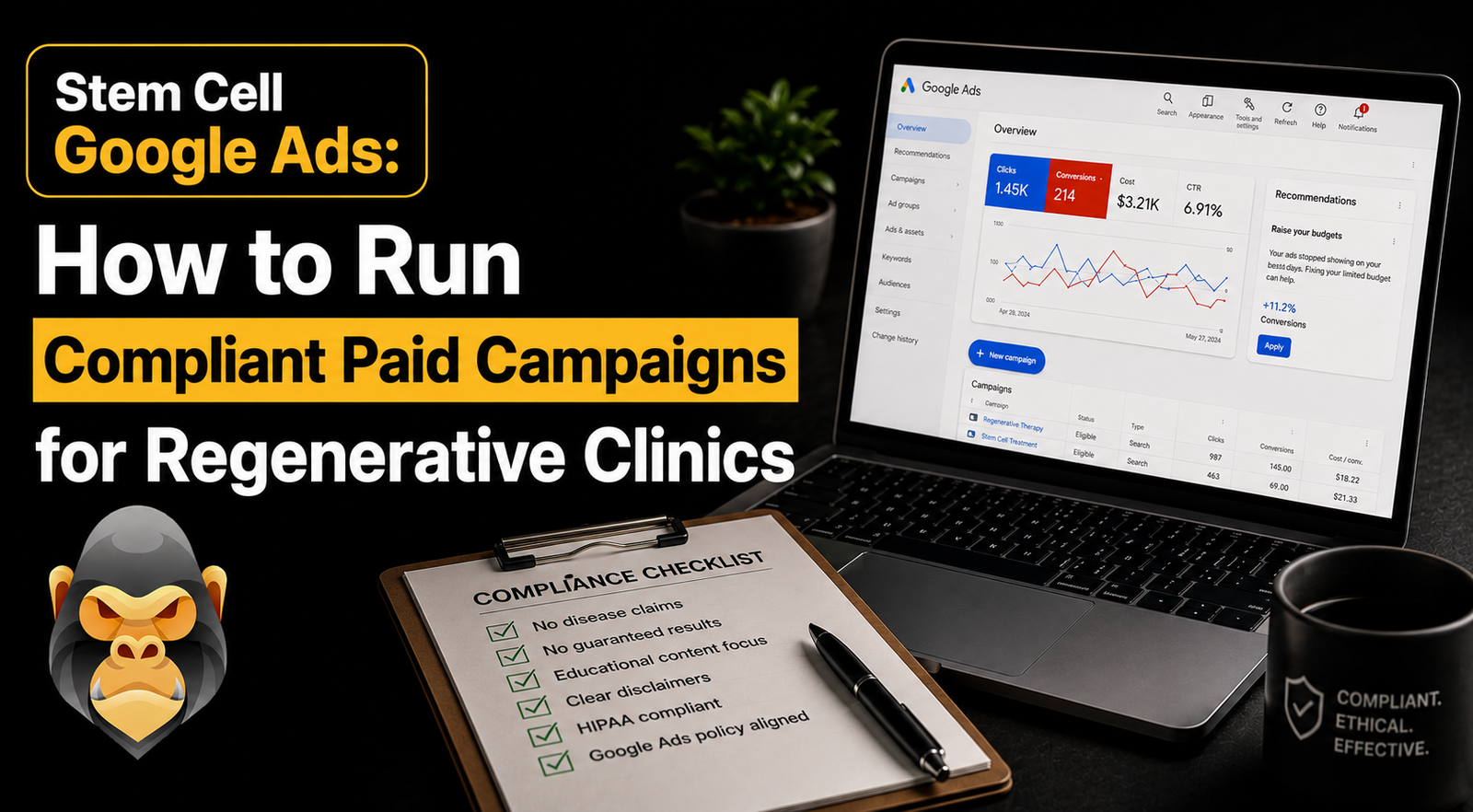
The paid advertising environment for regenerative medicine in 2026 is more navigable than most clinic owners believe but it requires knowing the specific compliance architecture that keeps campaigns live. Google’s educational content exception gives clinics a legitimate path to paid search, and retargeting campaigns for existing website visitors operate with significantly less policy friction than cold-audience campaigns. The complete guide to stem cell Google Ads covers the campaign structure, landing page architecture, and keyword strategy that produces compliant campaigns that stay live.
For clinics that have been burned by ad account suspensions or are starting fresh with paid search, the practical advice is to build layers one and two first establish the organic and content foundation and introduce paid as a supplementary channel once the conversion infrastructure is in place to receive that traffic.
The Regenerative Medicine Marketing Shift That Separates 2026 From Previous Years
Two things have changed the regenerative medicine marketing environment in 2026 more than any others.
The first is the maturation of Google’s local search algorithm. The signals that determine map pack rankings in 2026 review velocity, citation consistency, GBP engagement patterns, location-specific content signals are now more sophisticated and more decisive than they were two years ago. Clinics that have been building these signals consistently are pulling away from clinics that have not. The gap is widening, and it will continue to widen as the algorithm compounds authority over time.
The second is the acceleration of the patient research process across more channels simultaneously. Patients researching regenerative medicine in 2026 do not just use Google. They watch YouTube explainers, read Facebook discussions, check Google Maps reviews, and increasingly encounter AI-generated summaries before they ever reach a clinic’s website. The clinics that appear consistently across all of these touchpoints with credible, educational, compliant content at every stage are the ones that get the consultation call when the patient is finally ready to make contact.
- The regenerative medicine clinics that are building sustainable patient acquisition in 2026 are not the ones spending the most on ads. They are the ones that have built the deepest organic presence in the map pack, in organic search, in educational content and that presence keeps working whether or not they are running a campaign this month.
That is the fundamental shift. In 2022, a well-run Google Ads campaign could produce consistent regenerative medicine patient volume without much organic infrastructure behind it. In 2026, the platform restrictions, the patient skepticism, and the increasing sophistication of Google’s algorithm have made the organic foundation non-optional. Clinics that are still trying to shortcut that foundation with ad spend alone are fighting a losing battle against a trend that is moving in one direction.
What Regenerative Medicine SEO Looks Like When It Is Working
The question clinic owners ask most often is: how do I know if my regenerative medicine marketing is actually working? Here is what the working version looks like in concrete terms.
Channel | What Working Looks Like | What Not Working Looks Like |
Google Maps | Top 3 position for primary keywords in primary city and 2+ service areas | Position 8-15, inconsistent NAP, fewer than 20 reviews |
Organic Search | Condition-specific pages ranking page 1 for symptom-level queries | Homepage only, no condition pages, zero blog content |
Content | Consistent educational publishing generating organic traffic and review-stage trust | Last blog post from 18 months ago, no patient education resources |
Reviews | 4+ new reviews per month consistently, average 4.6+ stars, every review responded to | Sporadic reviews, last one 4 months ago, no owner responses |
Paid Ads | Educational-angle campaigns running without disapprovals, retargeting warm site visitors | Repeated account flags, campaigns relaunched every 30-60 days |
A regenerative medicine clinic with the first column in place across all five channels is building patient acquisition that compounds over time. One with the second column description across those same channels is running in place spending marketing budget without building the underlying asset that produces compounding returns.
The 2026 Regenerative Medicine Marketing Playbook Is Built on What You Own
Every regenerative medicine marketing trend worth paying attention to in 2026 points in the same direction: the practices that win patient volume are building owned visibility, not renting it.
AI overviews pull from content with established organic authority. Google Maps rewards clinics that have built consistent presence signals over time. Educational content that earns patient trust cannot be purchased through ad spend it has to be built. Reviews that convert skeptical patients are generated through systematic patient engagement, not manufactured.
The clinics that are investing in regenerative medicine SEO, structured local search optimization, and patient-education content in 2026 are building an asset that appreciates. The clinics that are running ad campaigns without that foundation are renting visibility that disappears the moment the spend stops or the platform changes its policy.
If you are running a regenerative medicine clinic in Texas or anywhere in the United States and want to understand what a structured, organic-first marketing strategy looks like for your specific practice and market the conversation starts with a free consultation with our team.
Explore Gorilla Marketing Experts stem cell and regenerative medicine marketing services → Stem Cell
FAQs About Regenerative Medicine Marketing in 2026
For most regenerative medicine clinics, the highest-return strategy is a coordinated organic approach: Google Maps local SEO as the primary patient acquisition channel, condition-specific content marketing to build trust with research-stage patients, and systematic review generation to support both map pack rankings and patient conversion. Paid advertising supplements this foundation but is not the foundation itself platform restrictions on regenerative medicine treatments make paid campaigns operationally demanding enough that they should not be the primary patient acquisition channel for most practices.
Google Maps ranking movement is typically measurable within 60 to 90 days of a structured local SEO campaign for most markets. Organic website rankings for condition-specific content take longer three to six months for initial page-one visibility in lower-competition markets, up to nine to twelve months in highly competitive metro markets. The compounding dynamic means that clinics which started building organic presence in 2024 and 2025 are seeing disproportionately strong results in 2026 as that authority accumulates.
Three factors that do not apply at the same intensity in most healthcare categories: a patient base that is skeptical by default and researches extensively before booking, advertising platform restrictions that eliminate the standard paid search playbook, and a trust deficit created by years of industry overclaiming that every compliant clinic must overcome in its content. Regenerative medicine digital marketing has to solve patient education, compliance, and trust simultaneously something that a general healthcare marketing template is not built to do.
Yes, but with the right architecture. Google Ads for regenerative medicine clinics require an educational content campaign structure, condition-based keyword targeting rather than treatment-name targeting, and isolated landing pages that prevent Google's scanner from finding restricted treatment terms through site navigation. The compliance complexity is real but manageable for clinics that understand the policy framework. For a detailed breakdown of how to build campaigns that stay live, our guide to stem cell Google Ads covers the complete campaign structure and disapproval recovery process.
Reviews are both a local search ranking signal and the primary patient conversion factor at the provider selection stage. A regenerative medicine clinic with consistent review velocity and a high average rating consistently outranks and out-converts competitors with fewer reviews regardless of which clinic's clinical work is superior. Systematic review generation, where the ask is made at the right moment in the patient journey and the process is frictionless, is one of the highest-return activities available to most practices. It is also one of the most consistently neglected.