

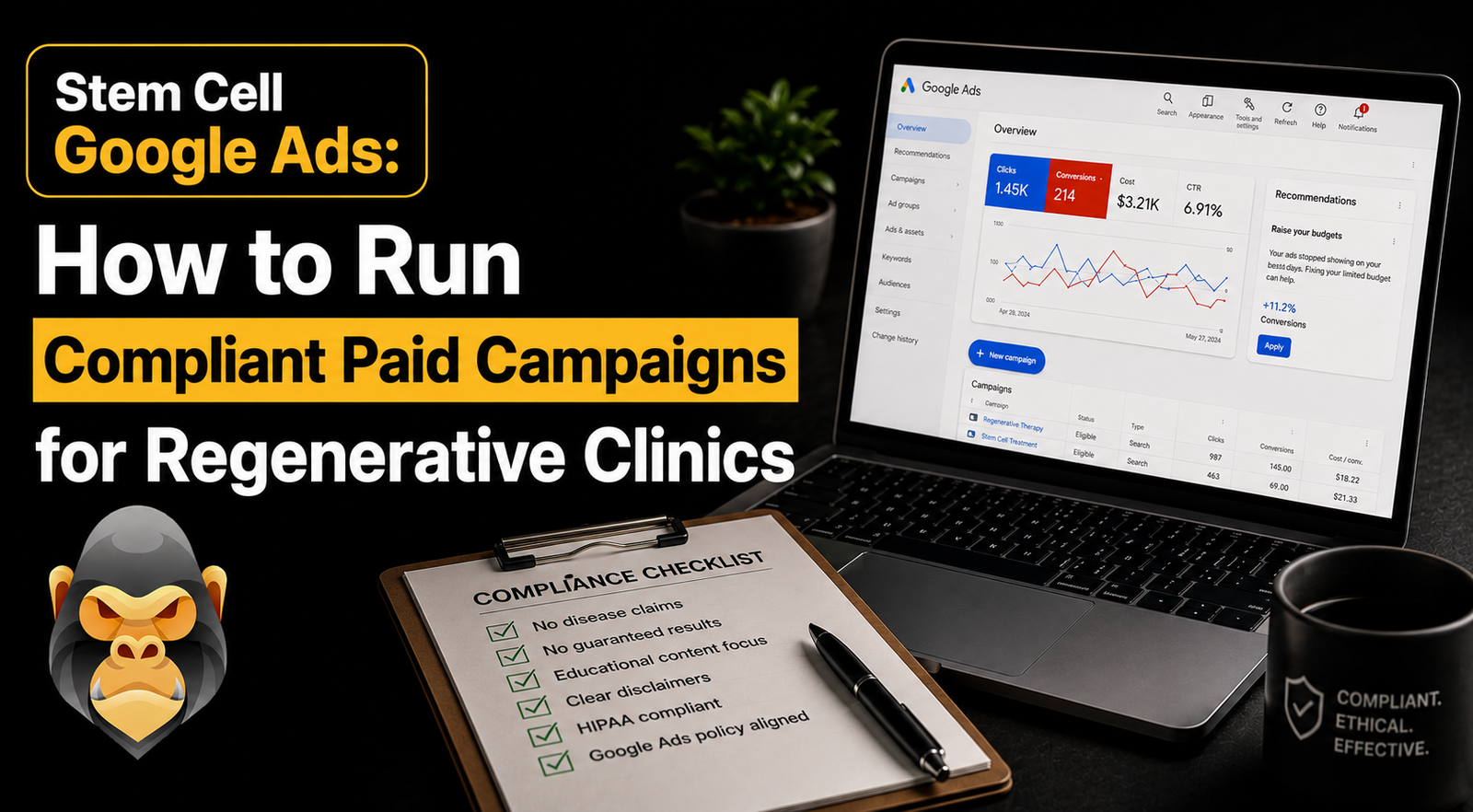
Stem Cell Google Ads: How to Run Compliant Paid Campaigns for Regenerative Clinics
Here is the situation most stem cell clinic owners have been in at least once.
You write a Google ad for orthopedic consultations. Nothing about stem cells. Nothing about PRP. Just a straightforward ad for a consultation about knee pain. It gets approved. The campaign runs for two weeks. Then every ad in the account gets flagged and the campaign goes dark not because of what the ad said, but because Google’s scanner followed the links on your landing page and found restricted terms three clicks deep in your website navigation.
You contact Google support. They tell you the account violated the speculative and experimental medical treatments policy. You ask which specific ad violated the policy. They cannot tell you. You fix what you think the problem is. The ads get rejected again.
This cycle destroys more stem cell clinic marketing budgets than any other single problem in paid advertising. And the reason it keeps happening is that almost every resource a clinic owner can find on this topic gives the same useless answer: Google Ads for stem cell therapy are restricted, so focus on SEO instead.
That answer is incomplete. Google Ads for stem cell clinics are restricted but they are not impossible. There is a specific, documented path to running compliant paid campaigns for a regenerative medicine practice that produce patient inquiries without triggering account suspensions. Understanding that path requires knowing exactly how Google’s policy works, how its enforcement system operates, and how to build campaigns and landing pages that stay on the right side of both.
That is what this guide covers. From the current policy language as updated in January 2026, to the educational content exception that gives regenerative medicine clinics a real advertising path, to the landing page architecture that keeps accounts live, to the keyword strategy that captures high-intent patients without triggering restrictions this is the definitive guide to stem cell Google Ads that most clinic owners have never found. For the full picture of how paid advertising fits into a broader stem cell marketing strategy, our stem cell marketing covers every acquisition channel including the organic channels that operate without any of these restrictions.
Most stem cell clinics approach social media the same way they approach a waiting room bulletin board. Post something occasionally, hope a patient sees it, and move on.
The result is a Facebook page with 180 followers that generates zero consultations, an Instagram profile with stock images of joints and brochure-style captions, and a YouTube channel with two videos from 2022 that nobody has watched. The social media presence exists. It just does not work.
That is not a social media problem. It is a strategy problem.
Stem cell media marketing the coordinated use of social platforms, video content, and educational media to build trust and drive patient inquiries is one of the most underutilized channels in regenerative medicine. Not because it is hard. Because most clinics either treat it as an afterthought or hand it to someone who does not understand the compliance environment well enough to use it effectively.
This guide covers how to build a stem cell media marketing strategy that actually moves patients through the research funnel platform by platform, content type by content type, with HIPAA compliance built into every layer. For the broader context of how media marketing fits into a full patient acquisition strategy, our guide to stem cell marketing for regenerative medicine covers the complete channel picture before this post goes deep on social and video specifically.
What Google’s Policy Actually Says About Stem Cell Advertising
Most clinic owners know Google restricts stem cell advertising. Very few have actually read the policy. That gap is what causes most of the account suspensions and disapprovals that shut down campaigns without warning.
Google’s Healthcare and Medicines advertising policy includes a specific section on speculative and experimental medical treatments. As updated in January 2026, that section prohibits direct promotion of the following:
- Stem cell therapy
- Cellular (non-stem) therapy
- Gene therapy
- Similar forms of regenerative medicine
- Platelet rich plasma (PRP)
The policy uses the phrase ‘speculative and/or experimental medical treatments’ as the umbrella category. This classification applies regardless of whether the treatment has FDA clearance for the specific use being advertised, regardless of the clinical evidence base behind it, and regardless of the state laws governing its practice. Google’s policy is not a regulatory determination about treatment efficacy it is a platform rule about what can be promoted on its advertising network.
The Enforcement Mechanism: Why Approved Ads Still Get Accounts Suspended
This is the part most clinic owners do not understand until it has already cost them an account suspension.
Google’s ad approval process runs on two layers. The first layer reviews the ad copy itself. The second layer which runs after initial approval and continues running throughout the campaign scans the landing page the ad links to, and then follows every link on that landing page to scan those pages as well.
A clinic that writes an ad for ‘orthopedic consultation for knee pain’ with no mention of stem cells can have that ad approved by layer one, run successfully for days or weeks, and then have the account flagged when layer two’s scanner discovers that the landing page links to a services menu that includes MSC therapy, or that the footer links to a blog post about PRP treatment.
The scanner does not distinguish between a direct treatment ad and a clinic website that happens to offer restricted treatments. If restricted terms appear anywhere reachable from the ad’s destination URL including navigation menus, blog posts, service pages, or footer links the account is at risk.
This is why clinics that think they have fixed the problem by editing their ad copy keep getting suspended. The ad was never the problem. The website architecture was.
The Policy Has Two Exceptions and One of Them Is Your Path Forward
Google’s speculative and experimental medical treatment policy does not prohibit all advertising by regenerative medicine clinics. It prohibits direct promotion of restricted treatments. Two exceptions are written into the policy:
- Exception 1: Educational content ads. Ads promoting content that is exclusively educational or informational about a restricted treatment not promoting the treatment itself, but explaining what it is, how it works, or what the research landscape looks like are permitted regardless of FDA approval status.
- Exception 2: FDA-approved treatments. Ads promoting FDA-approved treatments are permitted where the clinic can document the specific FDA approval for the specific use being advertised. For most stem cell clinic applications, this exception does not apply because most MSC therapy protocols are not FDA-approved for the conditions being treated.
Exception one is the real path forward for the vast majority of regenerative medicine clinics. Educational content advertising is specifically permitted and it is more effective as a patient acquisition strategy than most clinic owners realize, because research-heavy stem cell patients respond to educational content more readily than they respond to promotional ads.
Every competitor that gets their Google Ads account suspended is one less practice bidding on the keywords your patients search. Running compliant campaigns when others cannot is a genuine competitive advantage not just a compliance exercise.
The Educational Content Campaign: Your Compliant Path to Google Ads
The educational content exception gives stem cell clinics a legitimate, policy-compliant path to paid search advertising. Understanding how to build campaigns around this exception what qualifies as educational content, how to structure the ad, what the landing page needs to look like, and how to convert educational traffic into consultation bookings is the difference between a campaign that runs indefinitely and one that gets flagged within 30 days.
What Qualifies as Educational Content Under Google’s Policy
Educational content, in the context of Google’s policy exception, means content that explains, informs, or educates about a topic without promoting a specific treatment or service. For a stem cell clinic, this means:
- Content explaining what MSC stem cell therapy is, where the cells come from, and how they function biologically without promoting the clinic’s specific treatment program
- Content explaining a medical condition arthritis, peripheral neuropathy, degenerative disc disease and the range of treatment options that exist, of which regenerative medicine is one
- Content discussing the research landscape around regenerative medicine, including what studies have explored and what questions remain open
- Content explaining what a patient can expect at a regenerative medicine consultation the intake process, the evaluation, the treatment planning discussion
What does not qualify as educational content under this exception:
- Content that ends with a direct call to action to book a treatment
- Content that makes specific outcome claims reduce your joint pain by 70%’ even in an educational framing
- Content that implies the clinic’s treatment is superior to alternatives or that the treatment is proven effective for a specific condition
- Content that uses the educational format as a thin wrapper around a promotional message
The distinction is genuinely meaningful. Educational content builds the patient’s knowledge and helps them understand their options. Promotional content tries to close a transaction. Google’s scanner and increasingly Google’s human reviewers can tell the difference.
Building the Educational Campaign Structure
A compliant educational content campaign for a stem cell clinic is structured around the patient’s research questions, not around the clinic’s treatment offerings. Here is how it works in practice:
- Keyword targeting: Target condition-based keywords that patients search during Stage One and Stage Two of the research journey queries like ‘alternatives to knee replacement surgery,’ ‘what helps peripheral neuropathy pain,’ ‘non-surgical treatment for arthritis.’ These keywords describe the patient’s problem, not the clinic’s solution.
- Ad copy: Write ad copy that speaks to the condition and offers educational value Exploring non-surgical options for knee pain? Learn what regenerative medicine research has found.’ The ad promotes content, not treatment.
- Landing page: Land the patient on an educational page not a services page, not a treatment page, not a homepage with a treatment menu in the navigation. A standalone page that answers the question the keyword implied, written in genuine educational depth, with no navigation links to restricted treatment pages.
- Conversion path: Place the consultation offer at the bottom of the educational content as a natural next step If you want to discuss whether these options may be appropriate for your specific situation, our team offers a free consultation.’ The offer comes after the education, not instead of it.
This structure works because it matches how stem cell patients actually make decisions. They are not looking for a clinic that tells them to book now. They are looking for a clinic that treats them as an intelligent adult doing responsible research. An educational ad that delivers genuine value to a research-stage patient builds more goodwill and generates more consultation bookings than a promotional ad asking for an immediate commitment.
Landing Page Architecture: The Most Common Reason Accounts Get Suspended
The landing page is where most stem cell clinic Google Ads campaigns fail. Not because of what the landing page itself says but because of what Google’s scanner finds when it follows the links from that page to the rest of the website.
The Isolated Landing Page Approach
The most reliable way to keep a Google Ads campaign for a stem cell clinic running without account-level suspensions is to use a landing page that is architecturally isolated from the clinic’s main website. This means:
- No navigation menu linking to the main website’s treatment pages, services pages, or any page that mentions restricted treatments
- No footer with links to the full website
- No blog post sidebar showing recent posts that might include restricted treatment content
- No internal links to condition pages that name stem cell therapy or PRP as treatment options
- A standalone URL either a subdomain or a separate domain entirely that Google’s scanner cannot follow back to the main site’s restricted content
This approach is not deceptive. The clinic is not hiding what it does from patients the landing page should be honest about who the clinic is and what it offers. It is preventing Google’s scanner from finding restricted treatment content through the site architecture, which is a legitimate technical approach to campaign compliance.
For clinics that do not want to maintain a completely separate landing page domain, the alternative is a deeply stripped-down landing page on the main domain no navigation, no footer links to treatment pages, no internal links to any page containing restricted terms. This requires careful technical implementation but can be maintained on the main domain if the page is sufficiently isolated.
The Landing Page Content Standard
The content on the landing page itself needs to meet the educational standard consistently across the headline, the body content, any patient testimonials, and the call to action. Here is the content framework that works:
Page Element | Compliant Approach | What Gets Campaigns Flagged |
Headline | ‘Exploring non-surgical options for joint pain?’ | ‘Book stem cell therapy for your knee today’ |
Body content | Educational explanation of regenerative medicine options and what research has explored | Treatment promotion with outcome claims or effectiveness language |
Patient stories | Experience-based accounts with clear disclaimers that results vary and are not typical | Outcome testimonials claiming specific results ‘my arthritis was reversed’ |
CTA | ‘Schedule a free consultation to discuss your options’ | ‘Book your stem cell treatment’ or ‘Get PRP therapy now’ |
Navigation | Minimal or none no links to treatment pages or restricted content | Full site navigation linking back to treatment and services pages |
One additional landing page element that significantly reduces policy risk: an explicit disclaimer at the bottom of the page stating that the information presented is educational in nature, that the treatments discussed are not FDA-approved for all applications, and that patients should consult with a qualified physician before pursuing any treatment. This disclaimer does not just protect from FTC exposure it reinforces the educational positioning that protects the page from Google’s policy scanner.
Stem Cell Video Marketing: The Content Type That Closes the Trust Gap
Video is the most effective trust-building format available to a stem cell clinic. Not because patients prefer video to text in the abstract, but because the specific trust barriers that regenerative medicine patients carry skepticism about clinical claims, uncertainty about the provider, anxiety about the process are most effectively addressed by seeing and hearing a real physician explain the approach in their own words.
A written blog post about MSC therapy can be comprehensive and credible. A video of a physician with 15 years of regenerative medicine experience explaining the same information, looking directly into the camera, is something different. It is the closest thing to a consultation that a patient who has never contacted the clinic can access.
Stem Cell Therapy Video Content Ideas That Actually Perform
The question we hear most from regenerative medicine clinics starting a video strategy is: what should we make? Here is the content list built from what actually drives views, watch time, and consultation conversions for clinics in this category:
- ‘What is MSC stem cell therapy?’ the single most-searched educational query in the category. A 6-to-8-minute physician-led explanation that covers what mesenchymal stem cells are, where they come from, how they are prepared, and what the treatment process involves. This video ranks in YouTube search, appears in Google video results, and serves as the anchor piece for the entire video strategy.
- ‘Is stem cell therapy right for [condition]?’ condition-specific versions for arthritis, neuropathy, sports injuries, and any other primary patient profile. These videos target high-intent Stage Two searches and address the specific question patients are asking before they are ready to contact a clinic.
- ‘What happens at a stem cell therapy consultation?’ a walkthrough of the first patient touchpoint. This video reduces the anxiety of first contact, answers the questions patients are embarrassed to ask, and moves research-stage patients significantly closer to booking. It is one of the highest-conversion video formats in the category.
- ‘What is the difference between PRP and stem cell therapy?’ the most common comparison question patients search. A clear, honest explanation of how the two modalities differ, which conditions each is typically better suited for, and how a physician determines which protocol is appropriate for a given patient.
- ‘A day at [clinic name]’ a facility walkthrough showing the consultation room, the onsite laboratory, the treatment area, and the clinical team at work. This video answers the question patients have but rarely voice: what is it actually like to be a patient here? It is the closest equivalent to a facility tour for patients who cannot visit before booking.
- Patient journey videos with full HIPAA authorization, a patient sharing their experience from initial research through consultation and treatment. Not a clinical testimonial with outcome claims. A genuine account of what the process felt like, what the clinic experience was like, and why they decided to pursue treatment there. These videos generate more trust per minute of watch time than any other content format.
Short Form Video: Reels and YouTube Shorts for Stem Cell Clinics
Short-form video Instagram Reels, YouTube Shorts, and Facebook Reels has become the highest-reach organic content format available to most businesses. The algorithm on all three platforms amplifies short-form video to audiences beyond existing followers, making it the fastest path to new patient awareness for a clinic that is building its social media presence from scratch.
For stem cell clinics, the short-form video content that performs best is educational micro-content: 30-to-60-second videos that answer one specific question a patient would search for. Not promotional content. Not clinic advertising. Specific, useful, one-question-one-answer educational content that research-stage patients are actively looking for.
Examples of short-form video topics that generate high reach for regenerative medicine clinics:
- ‘The difference between stem cells and PRP in 60 seconds’
- ‘What does an onsite stem cell laboratory actually do?’
- ‘Three questions to ask any stem cell clinic before booking’
- ‘Why stem cell therapy costs more than a cortisone shot and what you get for the difference’
- ‘What MSC stands for and why it matters for your treatment’
Each of these topics answers a real question that research-stage patients ask. Each one positions the clinic’s physician or clinical team as a credible, knowledgeable source. And each one stays well within the compliance framework that governs regenerative medicine content because none of them makes a treatment outcome claim.
Keyword Strategy for Compliant Stem Cell Clinic Paid Search
The keyword strategy for a compliant stem cell clinic Google Ads campaign is built around one core principle: target the patient’s problem, not the clinic’s solution. Keywords that describe conditions, symptoms, and research questions produce compliant campaigns. Keywords that name restricted treatments produce disapprovals.
The Condition-Based Keyword Framework
These are the keyword categories that work for stem cell clinic Google Ads:
- Tier 1 Highest safety, strong intent: Condition searches: ‘knee pain not responding to treatment,’ ‘peripheral neuropathy alternatives,’ ‘alternatives to hip replacement,’ ‘bone on bone knee options,’ ‘autoimmune condition treatments.’ These keywords are symptom and condition level no treatment names, no restricted terms.
- Tier 2 Moderate caution, good intent: Research intent searches: ‘regenerative medicine for arthritis,’ ‘what is PRP therapy,’ ‘non-surgical orthopedic options,’ ‘biologic treatments for joint pain.’ These keywords mention the treatment category or modality without naming the specific restricted service.
- Tier 3 Provider-level targeting: Provider search keywords: ‘regenerative medicine clinic Dallas,’ ‘orthopedic specialist knee pain Texas,’ ‘non-surgical joint treatment near me.’ Location and specialty keywords that do not name restricted treatments.
Keywords that should be excluded from any compliant stem cell clinic campaign as negative keywords:
- stem cell therapy, stem cell treatment, MSC therapy, mesenchymal stem cell
- PRP injection, platelet rich plasma, PRP treatment
- exosome therapy, exosome treatment
- Any keyword that directly names a restricted treatment as the search term
The counterintuitive reality of this keyword strategy: the condition-based keywords that are safe for compliant campaigns are also the keywords that capture patients at the earliest and most valuable stage of their research journey. A patient searching ‘alternatives to knee replacement surgery’ is more likely to convert to a consultation booking than a patient searching ‘stem cell therapy Dallas because the first patient is still open to finding the right clinic, while the second patient may already have a specific provider in mind.
PRP Google Ads: The Slightly More Flexible Approach
PRP advertising sits in a different position than MSC stem cell therapy advertising, even though both appear on Google’s restricted treatment list. In practice, PRP campaigns face somewhat less aggressive enforcement than stem cell therapy campaigns though they are technically prohibited under the same policy language.
The safer approach for PRP Google Ads is the same educational content framework used for MSC therapy: condition-based keywords, educational landing pages, and consultation-offer CTAs rather than treatment-booking CTAs. The landing page compliance standard is identical. The difference is that PRP-related terms are slightly less likely to trigger automated scanner flags than stem cell therapy terms which means the margin for error is slightly wider, though not wide enough to justify a fundamentally different compliance approach.
For clinics offering both PRP and MSC therapy, the recommended approach is a single educational campaign architecture that covers both modalities without naming either in the ad copy or keyword targeting. The landing page can explain both treatments educationally without the campaign itself referencing restricted terms.
Exosome Therapy Paid Ads: The Highest-Risk Category
Exosome therapy advertising represents the highest compliance risk of any regenerative medicine modality on Google Ads. The FDA has specifically stated that most exosome products are regulated as drugs and require approval before they can be marketed therapeutically. Google’s scanner appears to treat exosome-related terms with particular sensitivity.
For clinics that offer exosome therapy, the recommendation is straightforward: do not run Google Ads that reference exosome therapy in any form educational or otherwise until the regulatory environment and Google’s policy enforcement around this modality becomes clearer. The compliance risk is higher and the enforcement scrutiny is more aggressive than for other regenerative medicine treatments. The organic channels covered in our guide to stem cell clinic local SEO produce results for exosome therapy clinics without any of this exposure.
Building a Stem Cell Clinic Content Calendar That Produces Results
A content calendar is not a posting schedule. A posting schedule tells you when to publish. A content calendar tells you what to publish, why, which patient it is for, and what stage of the research journey it serves. The distinction matters because a content calendar built around patient journey stages produces compounding results, while a posting schedule built around ‘what should we post this week’ produces inconsistency.
The Monthly Content Framework for a Stem Cell Clinic
A stem cell clinic publishing four to six pieces of content per week across platforms needs a framework that distributes content across patient journey stages, content types, and platforms without requiring the clinical team to generate new ideas from scratch every week. Here is the monthly framework we recommend:
Week | Content Type | Patient Stage | Platform Priority |
Week 1 | Condition education post + Reel | Stage 1 Awareness | Facebook + Instagram |
Week 2 | Physician explainer video | Stage 2 Consideration | YouTube + Facebook |
Week 3 | Patient journey content + Reels | Stage 2 Trust building | Instagram + Facebook |
Week 4 | Process / FAQ content | Stage 3 Decision | All platforms |
This framework ensures that every month of content reaches patients at awareness, consideration, and decision stages simultaneously which is important because at any given time, different patients in the clinic’s market are at different points in their research journey. A content calendar that only targets one stage produces results for a portion of the available patient pool and ignores the rest.
Content Batching: How Stem Cell Clinics Produce Consistent Content Without Burning Out the Team
The most common reason stem cell clinic social media strategies fail is not lack of ideas. It is inconsistency. The content calendar gets populated for two months, the physician gets busy, the posts stop, and by the time anyone returns to it the momentum is gone and the algorithm has stopped distributing the content.
Content batching solves this. One half-day session per month with the physician or clinical director, a camera, and a content plan can produce four to six short-form videos, two to three long-form YouTube scripts, and the raw material for 20-plus social posts. Batch produced, edited in a workflow, and scheduled in advance so the posting calendar runs automatically regardless of how busy the clinical team gets.
The clinics that maintain consistent social media presence over 12 months not perfect, not high-production, just consistent are the ones that build the audience depth and algorithmic distribution that makes social media a meaningful patient acquisition channel. Inconsistency is the only strategy that guarantees social media never works.
Fixing a Stem Cell Clinic Ad Disapproval: The Step-by-Step Process
If your Google Ads account has been flagged or suspended for speculative medical treatment policy violations, here is the recovery process that works:
Step 1. Audit Every Page Google Can Reach From Your Ads
Start with the destination URL in your disapproved ad. Open that page and follow every link it contains navigation menu, footer links, body content links, sidebar links. For each linked page, check for restricted terms: stem cell, MSC therapy, PRP, platelet rich plasma, exosome, gene therapy, regenerative medicine (in a treatment context rather than an educational context).
Document every page that contains restricted terms. This is the full scope of what Google’s scanner found. Fixing the ad copy without addressing these pages will result in repeat disapprovals.
Step 2. Isolate the Landing Page
Create a new landing page either on a subdomain or as a strictly isolated page on the main domain with no navigation links to restricted content. This page should contain only educational content, a consultation offer, and no pathways that lead Google’s scanner to restricted treatment pages.
Do not redirect your existing service pages to this new landing page. Create it as a separate destination, point your ads at it, and keep it architecturally clean.
Step 3. Update the Campaign Keywords and Ad Copy
Replace any ad copy that references restricted treatments with educational framing. Replace any keywords that directly name restricted treatments with condition-based alternatives. Review the full negative keyword list to ensure restricted terms are excluded.
Step 4. Submit for Review With a Clear Explanation
When submitting the corrected campaign for review, use Google Ads’ appeal process to explain that the campaign promotes educational content about treatment options and does not directly promote restricted treatments. Provide the URL of the isolated landing page and note that it contains no links to restricted content. This appeal documentation does not guarantee approval but significantly improves the likelihood of a favorable review outcome compared to a resubmission without explanation.
Step 5. Monitor the Account Actively After Reapproval
Google’s scanner continues running after initial approval. Any changes to your website that introduce new restricted content reachable from the landing page URL can trigger new disapprovals even weeks after the campaign was approved. Monitor the account weekly and audit the landing page’s link architecture whenever the main website is updated.
The most common mistake after fixing a disapproval: updating the main website with new treatment content a blog post about PRP results, a new stem cell services page without checking whether that content is reachable from the campaign’s landing page. One new internal link from an approved educational page to a restricted treatment page can reopen the disapproval cycle.
Retargeting Campaigns: The Paid Channel With the Least Compliance Friction
While top-of-funnel Google Ads for stem cell clinics require the careful compliance architecture described above, retargeting campaigns ads shown to people who have already visited the clinic’s website operate under significantly different enforcement dynamics.
Retargeting audiences are built from existing website visitors, which means the people seeing these ads have already shown interest in the clinic and its treatments. The ads are not introducing restricted treatments to a cold audience they are re-engaging people who have already made the choice to visit a regenerative medicine clinic’s website.
In practice, retargeting campaigns for stem cell clinics face less aggressive policy enforcement than cold-audience campaigns. The ads are less likely to be flagged because they are less likely to be reviewed with the same scrutiny as new top-of-funnel campaigns targeting general keyword searches.
The retargeting strategy that works for regenerative medicine clinics:
- Build retargeting audiences from all website visitors, filtered by pages visited patients who visited condition-specific pages are in a different consideration stage than patients who visited the consultation booking page
- Show educational content to early-stage visitors video explainers, blog post content, condition guides that continues building trust without making treatment claims
- Show consultation offers to visitors who have engaged with multiple pages or spent significant time on the site these patients are further along in the research journey and are ready for a more direct conversion message
- Keep retargeting ad copy in the educational-to-informational range ‘Ready to discuss your options? Our team offers a free consultation’ rather than making direct treatment references
Retargeting is also the lowest cost-per-acquired-patient paid channel for most regenerative medicine clinics because it reaches patients who are already warm who have already self-selected by visiting the clinic’s website and are in active consideration mode.
Google Ads vs Organic Search: How Paid and Organic Work Together for Stem Cell Clinics
The question clinic owners ask most often about Google Ads for stem cell therapy is some version of: is it even worth the complexity when organic search and Google Maps can produce patients without any of these compliance challenges?
The honest answer is that paid and organic are not competing strategies they serve different functions in the patient acquisition timeline.
Our guide to stem cell clinic local SEO makes the case for why Google Maps and organic search are the foundation of sustainable patient acquisition for regenerative medicine clinics. That case holds. Organic rankings produce patients at lower cost per acquisition, they compound over time, and they operate without the platform policy restrictions that make paid advertising in this category so operationally demanding.
But organic search takes time to build. A new clinic or a clinic expanding into a new service area does not have 6 to 9 months to wait for organic rankings to establish. During that window, compliant paid campaigns built on the educational content framework described in this guide can produce consultation volume while the organic foundation builds.
The coordinated approach that works for most stem cell clinics:
- Build the Google Maps and organic SEO foundation first this is the long-term patient acquisition engine and it should always be the primary investment
- Run compliant educational content campaigns to generate consultation volume during the months it takes for organic rankings to establish
- Use retargeting campaigns to re-engage website visitors who did not convert on first visit this is where paid advertising produces its best ROI for regenerative medicine clinics
- Scale back paid ad spend as organic rankings mature and the map pack visibility begins producing consistent consultation volume
This sequence treats paid advertising as a bridge strategy something that produces results during the organic build period, not a permanent dependency that creates ongoing compliance risk and ongoing cost. The stem cell marketing guide covers this full channel sequence in the context of the broader stem cell marketing strategy.
Run the Campaigns Your Competitors Cannot
Most regenerative medicine clinics have one of two relationships with Google Ads: they have tried it, gotten suspended, and given up entirely or they have never tried it because someone told them it was impossible.
Neither position is correct. Google Ads for stem cell clinics are not impossible. They require more structural discipline than paid campaigns in most healthcare categories isolated landing pages, condition-based keyword targeting, educational content framing, active account monitoring. But that complexity is also the barrier that keeps most competitors out.
Every stem cell clinic in your market that has given up on Google Ads is a clinic that is not bidding on the condition-based keywords your patients search. Every clinic that keeps running non-compliant campaigns and getting suspended is a clinic spending its budget on accounts that go dark instead of on patients who book consultations. The clinics that build compliant campaigns and maintain them properly are the ones capturing paid search traffic that their competitors have abandoned.
If you want help building a Google Ads strategy for your regenerative medicine clinic that operates within policy, produces consultation volume, and does not put your ad account at risk every time someone updates your website our team has navigated this environment for medical clinics across Texas and nationally.
Talk to Gorilla Marketing Experts about stem cell clinic paid search → How to Choose a Stem Cell Marketing Agency
FAQs About Stem Cell Google Ads and Regenerative Medicine Paid Advertising
Not through direct promotion of restricted treatments but yes through educational content campaigns. Google’s policy prohibits direct advertising of stem cell therapy, PRP, exosome therapy, and similar regenerative medicine treatments. However, the same policy explicitly permits ads promoting content that is exclusively educational or informational about these treatments. A clinic that builds campaigns around educational content, condition-based keyword targeting, and isolated landing pages with no navigation to restricted treatment pages can run Google Ads without violating the policy. The path exists. It requires specific structural discipline to execute reliably.
Almost certainly because of what Google’s scanner found on your landing page or the pages linked from it. Google’s enforcement system does not only review the ad copy it follows every link reachable from the ad’s destination URL and scans those pages for restricted terms. A navigation menu that links to your stem cell services page, a footer link to your PRP treatment page, or a blog post accessible from the landing page that discusses restricted treatments are all sufficient to trigger a disapproval or account-level flag. The fix is not editing the ad copy it is isolating the landing page from any content that contains restricted terms.
Condition-based and symptom-level keywords are the safest category: ‘alternatives to knee replacement,’ ‘non-surgical arthritis treatment,’ ‘peripheral neuropathy options,’ ‘joint pain specialist near me.’ Research intent keywords that reference the treatment category without naming specific restricted treatments also work: ‘regenerative medicine for joint pain,’ ‘biologic treatment options for arthritis.’ Keywords that directly name restricted treatments stem cell therapy, PRP injection, exosome treatment should be excluded as negative keywords and never used as targeting terms in a compliant campaign.
Both PRP and stem cell therapy appear on Google’s restricted treatment list and are technically prohibited from direct promotion under the same policy language. In practice, PRP advertising tends to face slightly less aggressive automated enforcement than stem cell therapy advertising though the same fundamental compliance framework applies to both. The safest approach for a clinic offering both modalities is a unified educational campaign that addresses the patient’s condition without naming either restricted treatment in the ad copy or keyword targeting. Exosome therapy sits at the highest-risk end of the spectrum and warrants the most conservative approach of the three modalities.
Account reinstatement timelines vary significantly depending on the severity of the policy violation and the completeness of the corrective action taken. Minor disapprovals individual ad rejections without account-level suspension are typically resolved within 24 to 72 hours when the campaign is corrected and resubmitted. Account-level suspensions for repeat policy violations can take one to four weeks for reinstatement, and reinstatement is not guaranteed on the first appeal. The most important factor in reinstatement speed is the quality of the appeal documentation specifically, a clear explanation of what was changed, evidence that the landing page is isolated from restricted content, and confirmation that the campaign now promotes exclusively educational content.