

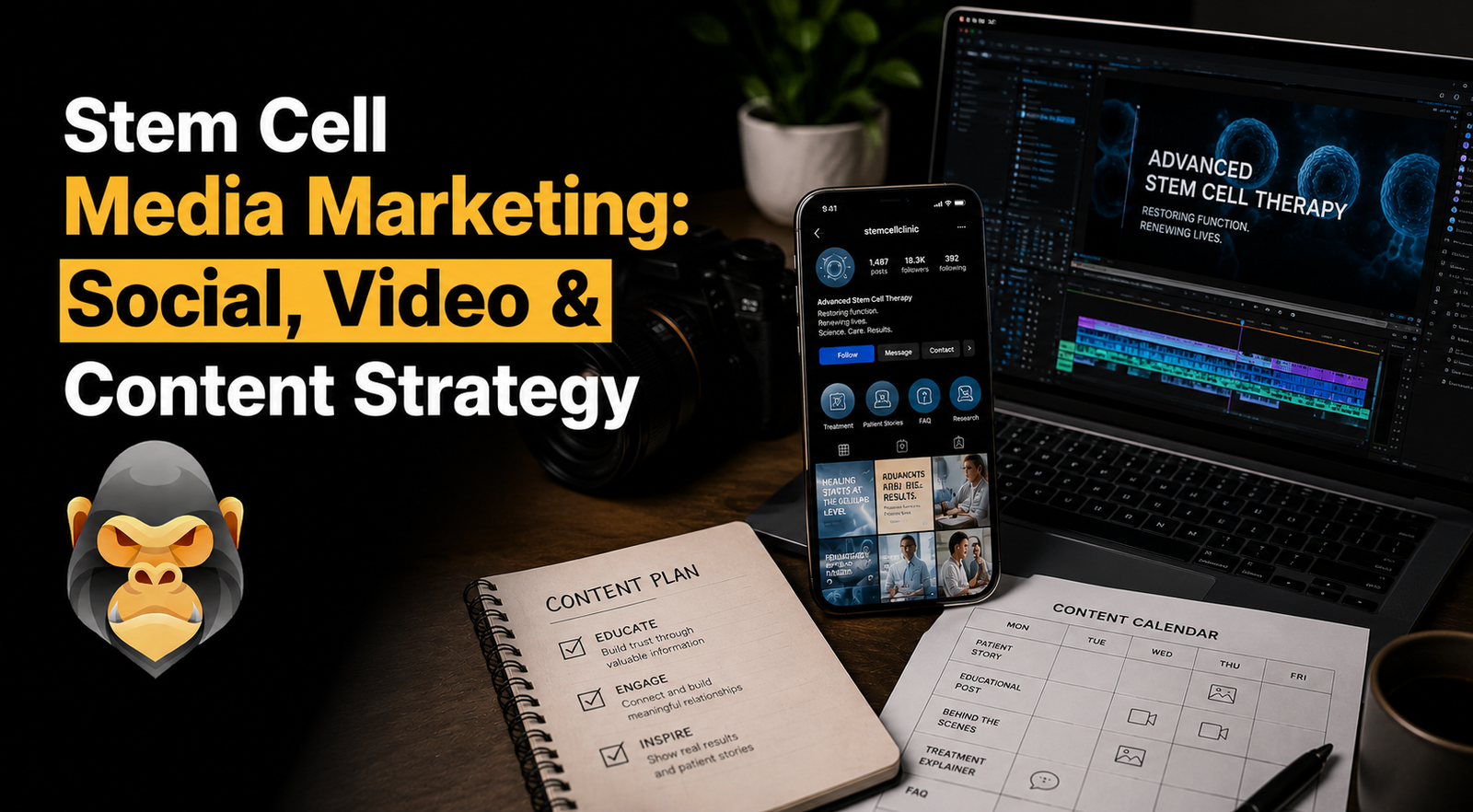
Stem Cell Media Marketing: Social, Video and Content Strategy for Regenerative Clinics
Most stem cell clinics approach social media the same way they approach a waiting room bulletin board. Post something occasionally, hope a patient sees it, and move on.
The result is a Facebook page with 180 followers that generates zero consultations, an Instagram profile with stock images of joints and brochure-style captions, and a YouTube channel with two videos from 2022 that nobody has watched. The social media presence exists. It just does not work.
That is not a social media problem. It is a strategy problem.
Stem cell media marketing the coordinated use of social platforms, video content, and educational media to build trust and drive patient inquiries is one of the most underutilized channels in regenerative medicine. Not because it is hard. Because most clinics either treat it as an afterthought or hand it to someone who does not understand the compliance environment well enough to use it effectively.
This guide covers how to build a stem cell media marketing strategy that actually moves patients through the research funnel platform by platform, content type by content type, with HIPAA compliance built into every layer. For the broader context of how media marketing fits into a full patient acquisition strategy, our guide to stem cell marketing for regenerative medicine covers the complete channel picture before this post goes deep on social and video specifically.
Why Stem Cell Media Marketing Requires a Different Approach Than Standard Healthcare Social
Healthcare social media marketing has a general playbook: post patient tips, share clinic updates, run the occasional promotion, respond to comments. That playbook works reasonably well for a primary care practice or a dental group.
It fails for stem cell clinics for three specific reasons.
The Compliance Environment Is More Restrictive
FDA guidance on regenerative medicine claims applies to social media content just as it applies to ads and websites. A Facebook post that says ‘stem cell therapy can reverse your arthritis’ is a compliance liability regardless of the platform it appears on. An Instagram Reel claiming patients are ‘cured’ of a chronic condition creates the same FTC substantiation problem as a landing page making the same claim.
Most social media managers even experienced healthcare social media managers do not know where the compliance lines are in regenerative medicine specifically. That knowledge gap is what produces the kind of social content that gives the FDA something to cite in a warning letter. The compliance framework that governs what a stem cell clinic can and cannot say applies equally to a Facebook post, a YouTube script, and a paid ad and our stem cell marketing guide covers that full compliance landscape in detail for anyone building a marketing strategy from the ground up.
Compliant stem cell social media content is possible. It just requires knowing the difference between mechanism-of-action content, patient experience content, and outcome claim content and staying on the right side of that line on every post, every caption, and every video script.
The Patient Needs Education Before Engagement
A patient considering a cosmetic procedure sees a before-and-after on Instagram and is ready to book a consultation within days. A patient considering stem cell therapy for a chronic condition is in the middle of a research process that typically takes weeks or months. They are comparing treatments, reading studies, watching explainer videos, and evaluating providers long before they are anywhere near making a first contact.
Social content that skips straight to ‘book a consultation’ messaging is aimed at a patient who does not yet exist for most regenerative medicine practices. The media marketing strategy that works for stem cell clinics is the one that meets patients in the research phase with educational content that builds credibility and keeps the clinic visible throughout the weeks they spend deciding.
Platform Algorithms Treat Medical Content Differently
Facebook and Instagram have content policies that flag or reduce the reach of health-related content that makes specific medical claims. YouTube has similar content guidelines for health and wellness videos. TikTok applies heavy restrictions to medical content. The practical implication: compliant, educational content tends to perform better algorithmically than promotional content not just from a regulatory standpoint, but from a pure reach standpoint.
Clinics that lead with educational content on social platforms routinely outperform clinics that lead with promotional content in organic reach, engagement, and ultimately in the consultation volume that social media contributes. The compliance-first approach is also the algorithm-friendly approach. That alignment is not coincidental.
The stem cell clinics generating real consultation volume from social media are not the ones with the biggest production budgets or the most followers. They are the ones publishing educational content consistently enough that research-stage patients keep seeing them throughout the weeks it takes to make a decision.
Platform-by-Platform Stem Cell Social Media Marketing Strategy
Different social platforms serve different functions in the stem cell patient acquisition funnel. The mistake most clinics make is treating every platform the same posting the same content everywhere and expecting consistent results. Each platform has a distinct audience behavior, content format, and role in the patient journey.
Facebook: The Research and Retargeting Platform
Facebook’s stem cell clinic audience skews older the 45-to-65 demographic that represents the highest-volume patient profile for most orthopedic and chronic condition stem cell practices. These are the patients managing arthritis, neuropathy, degenerative disc disease, and joint conditions. They use Facebook actively, they read long-form content, and they are in the research phase of a decision that matters enormously to their quality of life.
The Facebook content strategy for a stem cell clinic is built around three content types:
- Condition education: Educational posts explaining conditions, treatment options, and what the patient journey looks like written for a 55-year-old managing knee pain who has been told surgery is the next step, not for a medical professional
- Patient stories: Patient experience content with proper HIPAA authorization, written or video accounts of specific patients describing their condition, their decision to pursue treatment, and their experience with the clinic. These posts generate the highest engagement and the most meaningful social proof for research-stage patients
- Provider authority: Physician and clinical content short posts and videos featuring the clinic’s medical team explaining protocols, answering common patient questions, or walking through what a consultation involves. This content builds provider credibility faster than any other format
Facebook is also the strongest retargeting platform for stem cell clinics. Patients who visit your website, watch your videos, or engage with your content can be reached again with targeted follow-up content keeping your clinic visible during the weeks they spend researching. This retargeting function is separate from the ad compliance restrictions that govern top-of-funnel campaigns; retargeting warm audiences in this category operates with significantly less policy friction than cold-audience advertising.
Instagram: Visual Trust and Younger Patient Acquisition
Instagram serves a different function than Facebook in a stem cell clinic’s media strategy. The audience is younger 30-to-50-year-old patients who are often dealing with sports injuries, early-stage degenerative conditions, or anti-aging and longevity interests. The content format is visual-first, the attention window is shorter, and the content that performs best is more personal and less clinical than what works on Facebook.
Instagram Reels are the highest-reach format available to a stem cell clinic right now. Short-form video content 30 to 90 seconds explaining a condition, debunking a common misconception, or walking through what an MSC therapy consultation involves reaches audiences far beyond a clinic’s existing followers. The algorithm rewards educational Reels with broad distribution, and the compliance-friendly educational format aligns with what Instagram’s own content policies allow.
The Instagram content calendar for a stem cell clinic should include:
- Reels: short educational videos on conditions, treatment explainers, and clinic process. These drive reach with new audiences.
- Carousel posts: multi-slide educational content covering a topic in depth ideal for explaining the difference between PRP and MSC therapy, or walking through what to expect at a first consultation.
- Stories: behind-the-scenes clinic content, quick patient education tips, Q&A responses. These build familiarity with existing followers.
- Static posts: physician profiles, clinic environment photos, and treatment milestone content that builds profile credibility for patients who discover the account and scroll back through the feed.
One Instagram-specific compliance point that matters: before-and-after content is restricted on Instagram for medical procedures. Visible improvement claims tied to specific treatments fall under the same category as outcome claims on a landing page. The safest approach for patient experience content on Instagram is to focus on the patient’s journey and experience rather than on before-and-after comparisons.
YouTube: The Long-Form Trust Builder
YouTube occupies a unique position in stem cell media marketing. It is not a social platform in the traditional sense it is a search engine, and the second-largest one in the world. Patients researching stem cell therapy actively search YouTube for explainer content, physician interviews, and patient experience videos. A clinic with a well-optimized YouTube presence appears in both YouTube search results and in Google video results for regenerative medicine queries.
The stem cell clinic YouTube strategy that produces results is built around three content pillars:
- Educational content: Condition explainers: 5-to-10-minute videos explaining a specific condition arthritis, peripheral neuropathy, degenerative disc disease what causes it, what conventional treatments address it, and why regenerative medicine is an option worth researching. These videos target the Stage One search queries that represent the beginning of most patients’ research journeys.
- Treatment explainers: Treatment and process explainers: videos walking through what MSC therapy is, how the protocol works, what an onsite laboratory does, and what patients can expect from consultation through follow-up. These address the Stage Two research questions that patients ask before they are ready to contact a clinic.
- Physician authority: Physician content: interviews, Q&A videos, and clinical explanations delivered by the clinic’s medical director or treating physicians. Nothing builds provider authority faster than video content where a credible, articulate physician explains the science and the clinical approach in plain language. These videos do more conversion work than any other format in the stem cell marketing toolkit.
YouTube compliance follows the same framework as every other channel: mechanism-of-action and process content is safe, outcome claims and FDA-approval references are not. Video descriptions and titles are subject to the same FTC guidance as written content a video titled ‘How stem cell therapy cured my arthritis’ creates the same compliance exposure as a landing page making the same claim.
Stem Cell Clinic Facebook Marketing vs Instagram: Which Comes First
This is a question every clinic owner asks, and the honest answer is that it depends entirely on the primary patient demographic.
For a clinic that leads with orthopedic and chronic pain conditions arthritis, neuropathy, joint degeneration the patient profile skews 50-plus and Facebook is the primary platform. Start there, build the content calendar, establish the retargeting audience, and add Instagram as the secondary channel once the Facebook strategy is producing results.
For a clinic that leads with anti-aging, longevity, or sports medicine applications treatments that attract a younger, more aesthetically-motivated patient Instagram is the primary platform. The 35-to-50 patient considering exosome therapy for longevity or PRP for a running injury is on Instagram first and Facebook second.
Most stem cell clinics serve both patient profiles. The practical approach is to establish a presence on both platforms simultaneously but invest content production resources first in the platform that matches the primary patient demographic then cross-post adapted content to the secondary platform rather than producing entirely separate content for each.
Stem Cell Video Marketing: The Content Type That Closes the Trust Gap
Video is the most effective trust-building format available to a stem cell clinic. Not because patients prefer video to text in the abstract, but because the specific trust barriers that regenerative medicine patients carry skepticism about clinical claims, uncertainty about the provider, anxiety about the process are most effectively addressed by seeing and hearing a real physician explain the approach in their own words.
A written blog post about MSC therapy can be comprehensive and credible. A video of a physician with 15 years of regenerative medicine experience explaining the same information, looking directly into the camera, is something different. It is the closest thing to a consultation that a patient who has never contacted the clinic can access.
Stem Cell Therapy Video Content Ideas That Actually Perform
The question we hear most from regenerative medicine clinics starting a video strategy is: what should we make? Here is the content list built from what actually drives views, watch time, and consultation conversions for clinics in this category:
- ‘What is MSC stem cell therapy?’ the single most-searched educational query in the category. A 6-to-8-minute physician-led explanation that covers what mesenchymal stem cells are, where they come from, how they are prepared, and what the treatment process involves. This video ranks in YouTube search, appears in Google video results, and serves as the anchor piece for the entire video strategy.
- ‘Is stem cell therapy right for [condition]?’ condition-specific versions for arthritis, neuropathy, sports injuries, and any other primary patient profile. These videos target high-intent Stage Two searches and address the specific question patients are asking before they are ready to contact a clinic.
- ‘What happens at a stem cell therapy consultation?’ a walkthrough of the first patient touchpoint. This video reduces the anxiety of first contact, answers the questions patients are embarrassed to ask, and moves research-stage patients significantly closer to booking. It is one of the highest-conversion video formats in the category.
- ‘What is the difference between PRP and stem cell therapy?’ the most common comparison question patients search. A clear, honest explanation of how the two modalities differ, which conditions each is typically better suited for, and how a physician determines which protocol is appropriate for a given patient.
- ‘A day at [clinic name]’ a facility walkthrough showing the consultation room, the onsite laboratory, the treatment area, and the clinical team at work. This video answers the question patients have but rarely voice: what is it actually like to be a patient here? It is the closest equivalent to a facility tour for patients who cannot visit before booking.
- Patient journey videos with full HIPAA authorization, a patient sharing their experience from initial research through consultation and treatment. Not a clinical testimonial with outcome claims. A genuine account of what the process felt like, what the clinic experience was like, and why they decided to pursue treatment there. These videos generate more trust per minute of watch time than any other content format.
Short Form Video: Reels and YouTube Shorts for Stem Cell Clinics
Short-form video Instagram Reels, YouTube Shorts, and Facebook Reels has become the highest-reach organic content format available to most businesses. The algorithm on all three platforms amplifies short-form video to audiences beyond existing followers, making it the fastest path to new patient awareness for a clinic that is building its social media presence from scratch.
For stem cell clinics, the short-form video content that performs best is educational micro-content: 30-to-60-second videos that answer one specific question a patient would search for. Not promotional content. Not clinic advertising. Specific, useful, one-question-one-answer educational content that research-stage patients are actively looking for.
Examples of short-form video topics that generate high reach for regenerative medicine clinics:
- ‘The difference between stem cells and PRP in 60 seconds’
- ‘What does an onsite stem cell laboratory actually do?’
- ‘Three questions to ask any stem cell clinic before booking’
- ‘Why stem cell therapy costs more than a cortisone shot and what you get for the difference’
- ‘What MSC stands for and why it matters for your treatment’
Each of these topics answers a real question that research-stage patients ask. Each one positions the clinic’s physician or clinical team as a credible, knowledgeable source. And each one stays well within the compliance framework that governs regenerative medicine content because none of them makes a treatment outcome claim.
HIPAA Compliant Social Media for Stem Cell Clinics
HIPAA compliance in social media is not optional, and it is not limited to avoiding obvious violations like posting patient photos without consent. The compliance requirements for a stem cell clinic’s social media content are specific, and the violations that create real liability tend to be subtler than most clinic owners expect.
What HIPAA Requires on Social Media
HIPAA’s social media requirements for healthcare providers center on one principle: no patient health information can be disclosed without explicit authorization. In practice, that means:
- Patient photos, videos, or testimonials require signed, specific HIPAA authorization before being published. The authorization must specify the platform, the type of content, and the duration of use. A general ‘marketing consent’ form signed at intake is not sufficient the authorization needs to be specific to the content being published.
- Responding to comments or messages on social media that reference a patient’s condition, treatment, or appointment constitutes a disclosure if it confirms or denies the person’s patient status. Responding publicly to a comment that says ‘I had my stem cell treatment here last week’ with anything beyond a generic response can create a HIPAA liability.
- Patient review responses on Google, Facebook, and Yelp must be written carefully acknowledging the reviewer without confirming whether they are a patient or disclosing anything about their care. ‘We appreciate your feedback and would love to connect with you directly’ is compliant. ‘We are glad your knee treatment went well’ is not.
- Staff social media posts about their work even without names can create HIPAA exposure if they describe a patient case in enough detail that the patient could potentially be identified. This requires staff training, not just a policy document.
Building HIPAA Compliance Into the Content Calendar
The practical approach to HIPAA-compliant stem cell social media is to build the authorization process into the patient journey rather than treating it as an afterthought. Clinics that consistently generate patient experience content have a standard process: patients who express satisfaction after treatment are presented with a specific HIPAA-compliant authorization form at the time they are most willing to participate which is also the time they are most willing to leave a review or share their experience.
The authorization form should specify exactly what content will be created (written testimonial, video, photo), which platforms it will appear on (clinic website, Facebook, Instagram, YouTube), and how long it may be used. A patient who authorizes a video testimonial for use on Instagram but not YouTube requires separate authorization before that video can be published to the YouTube channel.
This level of specificity protects the clinic from HIPAA exposure and also protects the patient from having their health information used in ways they did not explicitly agree to. Both matter one legally, one ethically.
Building a Stem Cell Clinic Content Calendar That Produces Results
A content calendar is not a posting schedule. A posting schedule tells you when to publish. A content calendar tells you what to publish, why, which patient it is for, and what stage of the research journey it serves. The distinction matters because a content calendar built around patient journey stages produces compounding results, while a posting schedule built around ‘what should we post this week’ produces inconsistency.
The Monthly Content Framework for a Stem Cell Clinic
A stem cell clinic publishing four to six pieces of content per week across platforms needs a framework that distributes content across patient journey stages, content types, and platforms without requiring the clinical team to generate new ideas from scratch every week. Here is the monthly framework we recommend:
Week | Content Type | Patient Stage | Platform Priority |
Week 1 | Condition education post + Reel | Stage 1 Awareness | Facebook + Instagram |
Week 2 | Physician explainer video | Stage 2 Consideration | YouTube + Facebook |
Week 3 | Patient journey content + Reels | Stage 2 Trust building | Instagram + Facebook |
Week 4 | Process / FAQ content | Stage 3 Decision | All platforms |
This framework ensures that every month of content reaches patients at awareness, consideration, and decision stages simultaneously which is important because at any given time, different patients in the clinic’s market are at different points in their research journey. A content calendar that only targets one stage produces results for a portion of the available patient pool and ignores the rest.
Content Batching: How Stem Cell Clinics Produce Consistent Content Without Burning Out the Team
The most common reason stem cell clinic social media strategies fail is not lack of ideas. It is inconsistency. The content calendar gets populated for two months, the physician gets busy, the posts stop, and by the time anyone returns to it the momentum is gone and the algorithm has stopped distributing the content.
Content batching solves this. One half-day session per month with the physician or clinical director, a camera, and a content plan can produce four to six short-form videos, two to three long-form YouTube scripts, and the raw material for 20-plus social posts. Batch produced, edited in a workflow, and scheduled in advance so the posting calendar runs automatically regardless of how busy the clinical team gets.
The clinics that maintain consistent social media presence over 12 months not perfect, not high-production, just consistent are the ones that build the audience depth and algorithmic distribution that makes social media a meaningful patient acquisition channel. Inconsistency is the only strategy that guarantees social media never works.
Regenerative Medicine Content Marketing: The Organic Search Layer
Social media and video content do not operate in isolation from the broader stem cell marketing strategy. The educational content that performs best on social platforms is the same content that builds organic search authority when it appears on the clinic’s website. The two channels reinforce each other when they are built around the same patient questions and the same keyword targets.
A blog post explaining ‘what is MSC stem cell therapy’ that ranks on Google for that search query also becomes the script for the YouTube explainer video on the same topic which earns watch time, builds YouTube channel authority, and drives traffic back to the blog post through the video description. The patient who finds the blog post organically and the patient who finds the YouTube video through a search are at the same stage of their research journey and need the same information. Building that content once and distributing it across both channels is the most efficient use of the content production investment.
This content amplification approach publish on the website, adapt for YouTube, condense for Instagram Reels, repurpose into Facebook posts is what allows a stem cell clinic to maintain a consistent presence across multiple platforms without requiring a separate content production workflow for each one. For a deeper look at how the full content and SEO strategy works together for regenerative medicine practices, our guide to stem cell clinic local SEO covers the organic search layer that social media content feeds into.
The stem cell clinics that are building sustainable patient acquisition through media marketing are not producing more content than their competitors. They are producing content that serves a specific patient at a specific stage of the research journey and distributing it across every channel that patient uses during the weeks they spend deciding.
Stop Treating Social Media as an Afterthought
A stem cell clinic’s social media presence is either working for it or it is not working at all. There is no meaningful middle ground where occasional posting with no strategic framework produces a slow trickle of consultations. The platforms reward consistency, specificity, and genuine patient value and they ignore everything else.
The good news is that almost no competitor in the stem cell clinic space is doing this well. The Facebook pages are dormant. The YouTube channels have two videos. The Instagram profiles are stock images and promotional captions. The gap between what most clinics are doing with social media and what is actually possible is wider in this category than in almost any other healthcare niche.
That gap is yours to close. A consistent, compliant, patient-journey-aware stem cell media marketing strategy that runs for 12 months will produce results that most clinics in your market cannot match because most of them will still be posting occasionally and wondering why it is not working.
If you want to understand what a coordinated stem cell media marketing strategy looks like alongside the Google Maps SEO and organic search foundation that turns social media reach into actual consultation bookings the conversation starts with a free consultation with our team.
See how Gorilla Marketing Experts builds stem cell patient acquisition systems
FAQs About Stem Cell Media Marketing
It depends on your primary patient demographic. For clinics treating chronic orthopedic and pain conditions the 50-plus patient managing arthritis or neuropathy Facebook is the primary platform. The audience is active, the content consumption behavior skews toward longer educational posts, and the retargeting capabilities are strong. For clinics with a younger patient profile focused on anti-aging, longevity, or sports medicine, Instagram is the primary platform with its Reels format driving the broadest organic reach. Most stem cell clinics serve both demographics and should maintain a presence on both, investing production resources first in the platform that matches the primary patient profile.
Mechanism-of-action content, process explainers, and condition education are the safest content categories. Describing how mesenchymal stem cells work at a biological level, walking through what happens at a consultation, and explaining the conditions a clinic works with all of these build credibility without creating FDA or FTC compliance exposure. The content that creates risk is outcome-based: posts that claim treatments cure, reverse, or guarantee improvement in a specific condition. Patient testimonials are safe when properly authorized and when they describe experience rather than medical outcomes, and when they include the required disclaimer that results may vary and are not typical.
HIPAA applies to any content that could disclose patient health information. That means patient photos, videos, and testimonials require specific written authorization before they can be published and that authorization needs to name the specific platforms the content will appear on. It also means that responding publicly to social media comments or reviews requires care: confirming or denying a person’s patient status, or referencing anything about their care, in a public response constitutes a potential disclosure. Staff social media posts about clinical work, even without patient names, require the same caution if the description is specific enough that the patient could potentially be identified.
Yes, with important caveats. YouTube advertising for regenerative medicine follows Google’s healthcare advertising policies direct treatment claims, implied FDA approval for unapproved therapies, and outcome guarantees are all policy violations. Educational-angle ads that explain a condition and suggest the viewer learn more about their options are the most reliable compliant approach. Physician-delivered content that establishes expertise without making direct treatment claims also tends to perform well within YouTube’s policy environment. The same compliance framework that governs search and display advertising applies to YouTube pre-roll and in-stream ads.
Consistency matters more than frequency. A clinic publishing three times per week every week for 12 months will outperform a clinic that posts daily for two months and then goes dormant. For most stem cell clinics working with a realistic content production capacity, four to six posts per week across platforms distributed across Facebook, Instagram, and YouTube is a sustainable cadence that maintains algorithmic distribution and keeps the clinic visible to patients throughout their research process. The content batching approach, producing a month’s content in a single half-day session, is the most practical way to maintain that consistency without overwhelming the clinical team.